Base model Qwen3.5-9B (scale-up: Qwen3.6-27B, QLoRA 4-bit) · WebShop env, 100 held-out Word2World goals shared by every method · Score = mean reward×100, SR = % episodes with reward 1.0 · greedy decoding throughout.
WebShop is a simulated shopping site: the agent gets a natural-language instruction ("a 3 oz bottle of bright citrus deodorant for sensitive skin, under $50"), and must search, click a product, select options (size/color/count), and Buy Now. Reward ∈ [0,1] measures how well the purchased item matches the instruction's attributes; reward = 1.0 counts as success. An episode is a chain of Observation → Reasoning → Action steps (the ORA chain).
search[...] or click[...]. No reasoning text at all. This is the paper's "Act" ablation: acting from memory, without thinking.think[...], which does not touch the environment (it just gets "OK." back) and is kept in-context to guide later actions. Reasoning and acting interleave: think about what the results mean → act on the conclusion. In the paper (PaLM-540B) this beats Act because the thoughts plan, track sub-goals, and decide when to commit. Crucially, each thought costs one of the 15 loop steps, so thinking has a budget price. Faithful replication: their exact few-shot prompts, greedy, stop-at-newline, 6400-char context.[obs_0][think_0][act_0][obs_1]…. Three design choices define it: (1) full history — the whole trajectory is the context, so the model learns to act conditioned on everything that happened; (2) loss masking — cross-entropy only on think+act tokens; observations are context, never predicted (this stops the model from drifting into page-text generation); (3) self-distilled reasoning — the think text ("Prediction: … Reason: …") is generated by the same model viewing the realized next observation (privileged context), then distilled in — a forward-dynamics rationale, not a teacher's plan. Trained to convergence with early stopping on a shared held-out validation set (same criterion for every cell → fair scaling comparisons).| mode | what is consolidated after each episode | tests |
|---|---|---|
| frozen | nothing — pure in-context agent, ΔW never changes | control: is the climb caused by consolidation? |
| everything | all events (loss on obs+think+act), every episode | pure continual accumulation |
| reward_gated | observations always (world model); think+act only if reward ≥ 0.5 | don't reinforce bad behavior |
| hybrid | reward_gated + recall-replay of a past high-reward episode at its original G-positions | full human-learning recipe: gated consolidation + rehearsal + time |
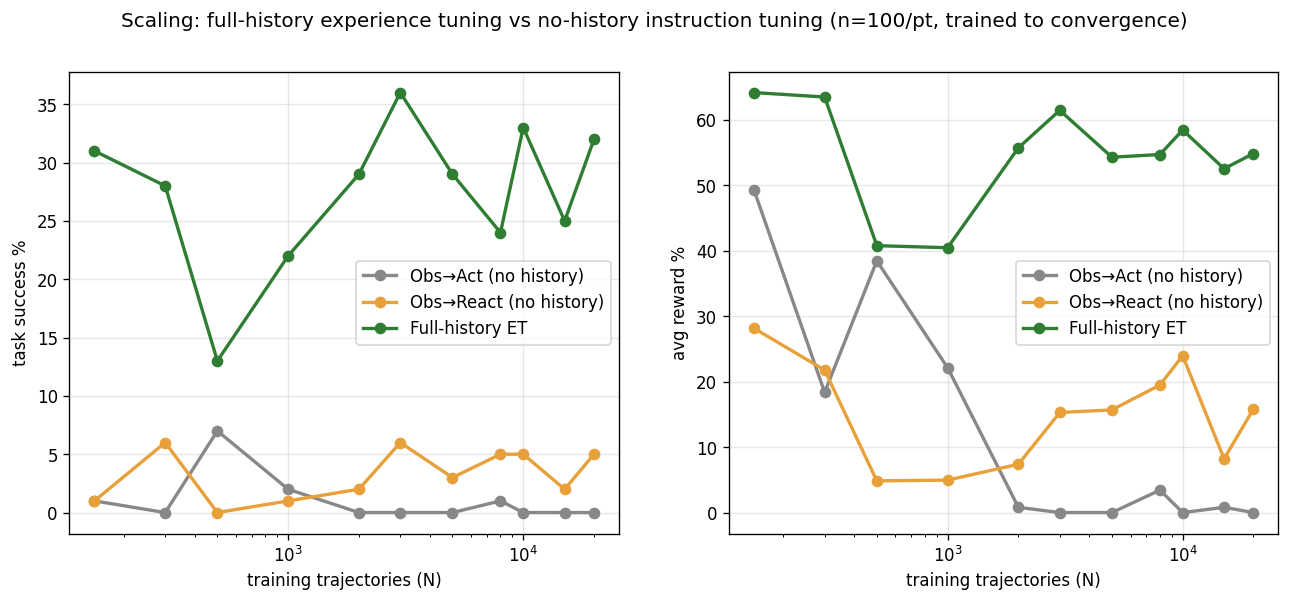
Full-history ET holds SR 22–37% across N = 150…20,000 training trajectories. The memoryless ablations stay near zero at every N — more data cannot fix a policy that can't remember what it already tried. Obs→Act actively collapses (it converges onto the dominant action and loops); Obs→React drifts up only slightly.
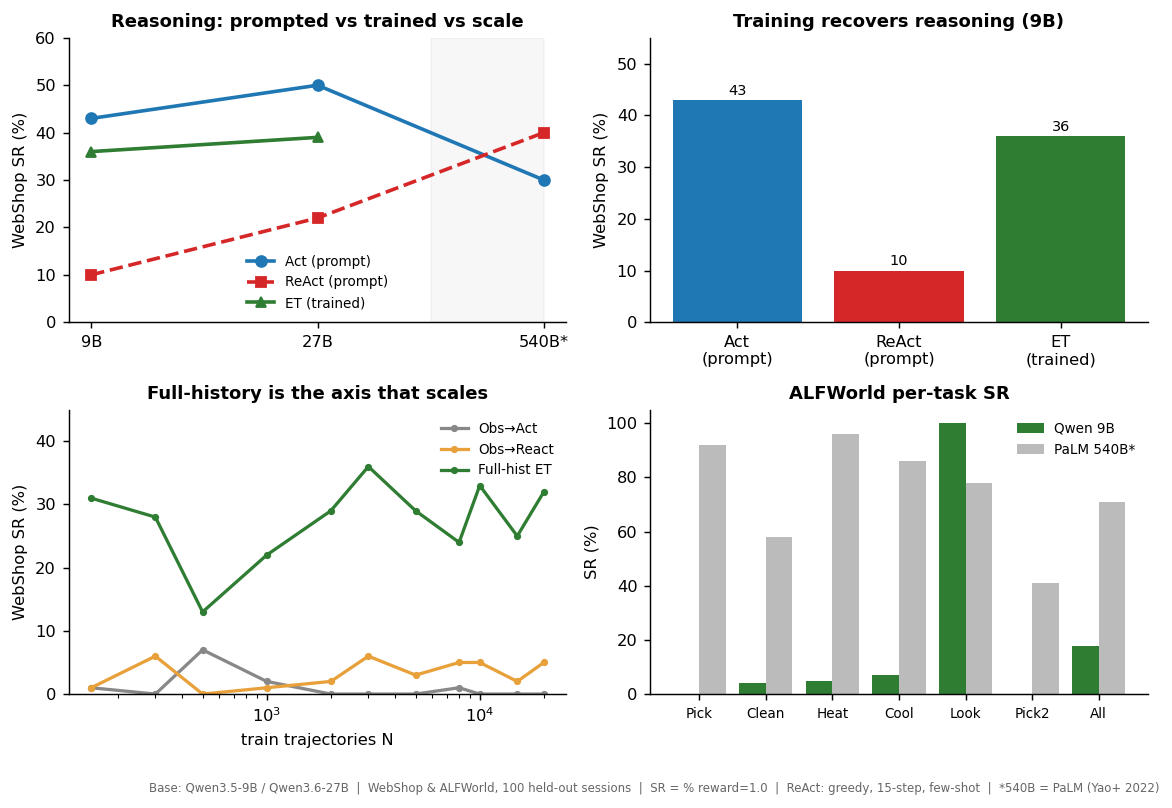
| WebShop | Act (prompt) | ReAct (prompt) | ET (trained) |
|---|---|---|---|
| Qwen 9B | SR 43 | SR 10 | SR 36 |
| Qwen 27B | SR 50 | SR 22 | SR 39 |
| PaLM 540B (paper, reported) | SR 30 | SR 40 | — |
The think-trap. Prompted ReAct collapses at small scale for a verified reason (same-session traces): after an identical search returning identical results, Act clicks the product and buys; ReAct thinks "no item matches" — false — and re-searches the same query until the step budget dies (87/100 episodes). The reasoning step injects miscalibrated judgments and pays a step tax. It fades with scale (10→22→40) but only overtakes Act somewhere between 27B and 540B. Training the reasoning (ET) fixes the loop (36/39 ≫ 10/22) but still trails plain Act — on WebShop, at these scales, reasoning of any kind underperforms just acting with full history. The native-chat rebuild confirms this is robust, not a format artifact: native think SR 51 vs native act 57 at n=100 (an early n=20 think>act read was sampling noise). ALFWorld mirrors the story (9B prompted ReAct: 17.6% vs paper's 71%; only the trivial "examine" task solves).
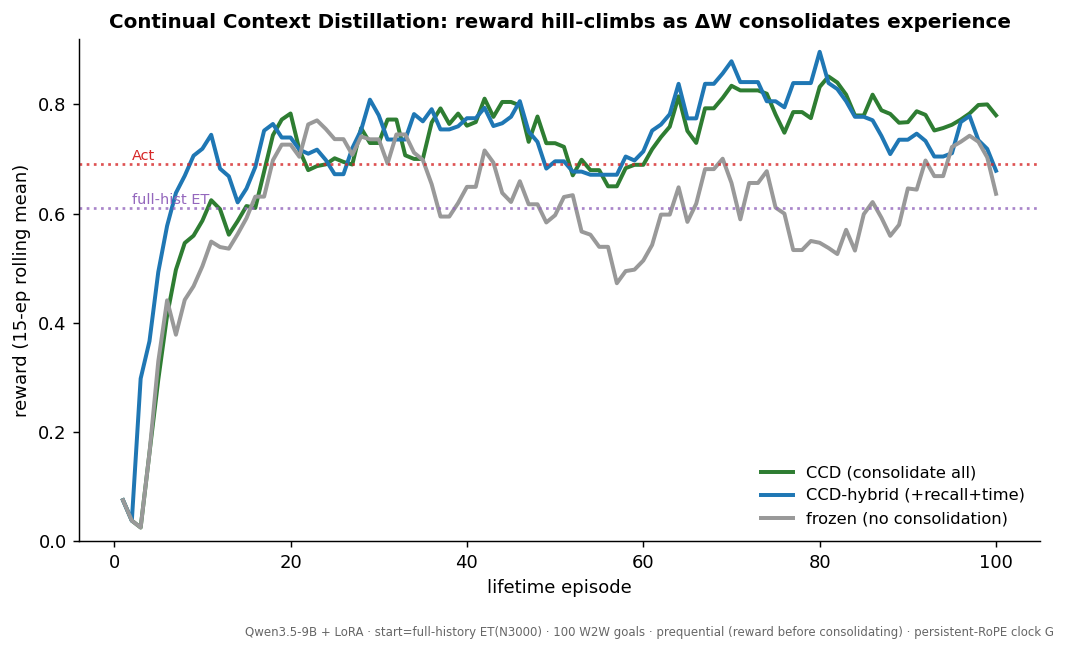
| lifetime mode | overall | first⅓ → last⅓ | climb | SR |
|---|---|---|---|---|
| CCD everything | 0.739 | 0.661 → 0.800 | +0.138 | 0.40 |
| CCD hybrid | 0.740 | 0.709 → 0.753 | +0.044 | 0.46 |
| reward_gated | 0.738 | 0.750 → 0.706 | −0.043 | 0.43 |
| frozen (control) | 0.623 | 0.658 → 0.592 | −0.066 | 0.36 |
| static: Act / ET / ReAct | 0.69 / 0.61 / 0.12 | flat by construction | ||
Caveats kept honest: the Score win is on partial-match reward; on exact-success SR the native-chat Act agent (0.57) is higher, but it is a different rollout harness — the like-for-like comparison is CCD vs frozen. Design-A's persistent-time machinery did not move frozen task success (null) — its value shows up here, in the lifetime setting. The reward_gated dip suggests gating starves the world-model updates early; "everything" climbs highest.
Memoryless policies fail WebShop regardless of data; history is the only axis that scales. Prompted reasoning is a tax small models cannot afford (the think-trap), and even trained or native-format reasoning does not beat plain acting in a frozen model. The decisive ingredient is not reasoning but accumulation: when experience streaming through the context is continually distilled into the weights — gated, rehearsed, and time-stamped like human memory consolidation — the same model that plateaus when frozen instead keeps getting better the longer it lives, finishing above every static baseline. Context, consolidated, is the new weight.
Artifacts: scaling_curve.html (per-cell numbers) · react_replication.html (replication tables)
· scripts in exp/scripts/ (train_react_wm.py, lifetime_agent.py, react_baseline_webshop.py,
react_native_webshop.py, ccd_analyze.py) · all evals on the same 100 held-out goals.